
A look at key developmental stages and how Eddie supports your child's natural growth through everyday moments.
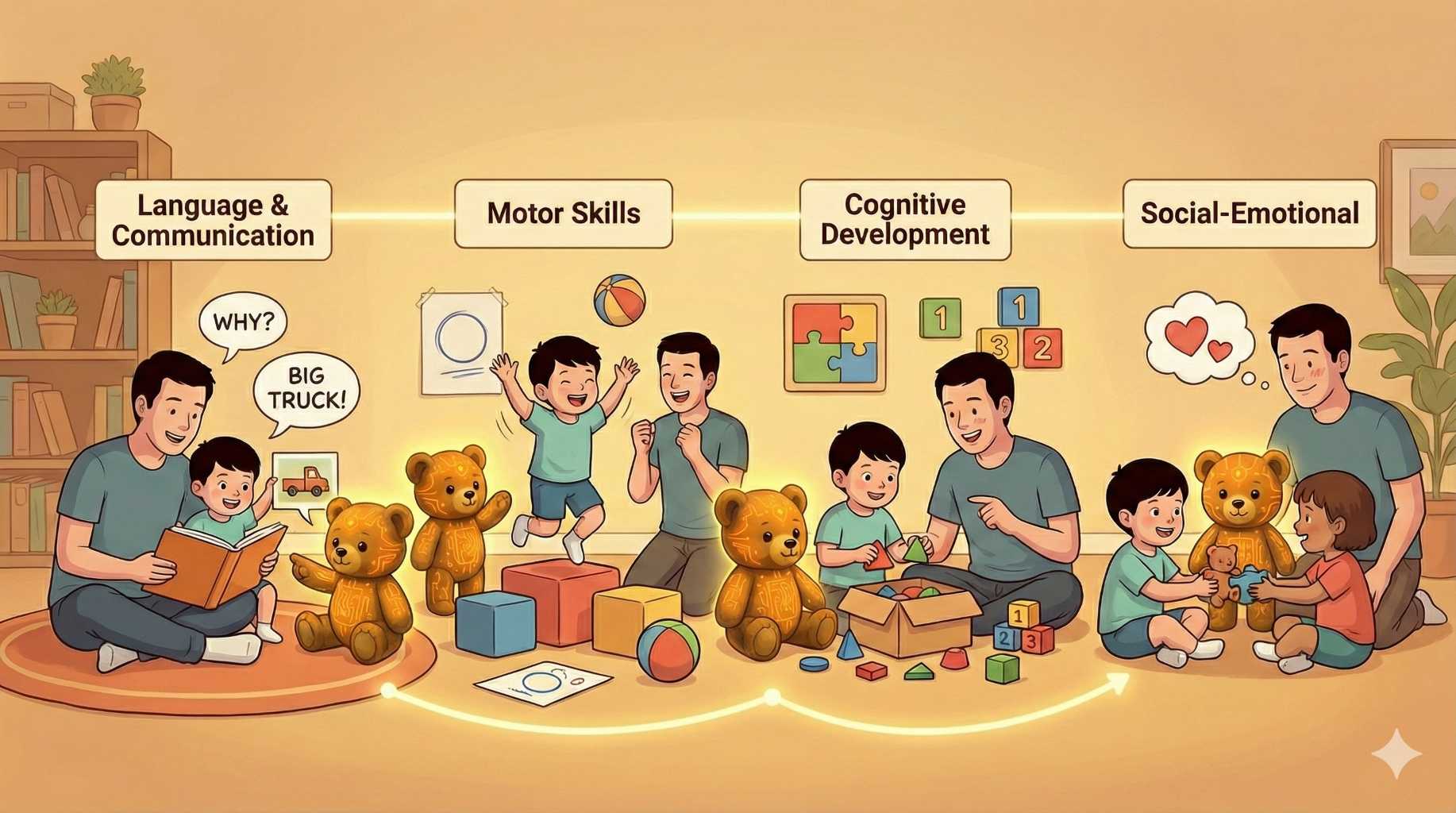
Every child develops at their own pace, but there are common milestones that signal progress across language, motor skills, cognitive abilities and social–emotional growth. Understanding these stages can help you nurture your child's abilities without unnecessary worry or comparison. Here's an overview of evidence‑based milestones for ages 2–8 and how Eddie, the AI Bond Weaver, helps you support each one naturally.
Between ages two and four, children's vocabularies explode. They start forming simple sentences, asking endless “why” questions, and describing events from their day with increasing clarity.
By ages five to eight, many children tell simple, coherent stories and follow multi‑step directions. Between six and eight years, narratives become more detailed, and they discuss thoughts and feelings with increasing specificity. Reading and writing skills emerge around six to seven years, and by seven to eight years, children use language to explain reasons, compare ideas, and support their opinions.
Eddie supports language development through rich storytelling, open‑ended questions, and age‑appropriate vocabulary expansion. It encourages children to practice speaking and listening while offering you thoughtful prompts to extend conversations naturally, helping you build your child's communication confidence without feeling like you need a script.
Between two and three years, children typically run, jump with both feet, throw a ball, and may begin to catch a large ball. They scribble spontaneously and start imitating simple lines and circles, building the foundation for writing.
From six to eight years, handwriting becomes more controlled, and participation in organized sports increases. Many children tie their shoes by five to seven years and learn to ride a bicycle sometime between four and eight years, often mastering riding without training wheels by six to eight.
During active play, Eddie encourages movement through interactive games and scavenger hunts, reminding you of the importance of physical development while suggesting age‑appropriate challenges. It turns everyday moments into opportunities to practice coordination and fine motor skills like counting while jumping or drawing shapes while storytelling.
Object permanence emerges in infancy (about 8–18 months). By two to three years, children commonly sort objects by shape or color and complete simple puzzles, showing growing problem‑solving abilities and pattern recognition.
Simple addition and subtraction are learned in the early school years, typically around ages five to seven. Conservation of amount, weight, and volume. Understanding that quantity doesn’t change when appearance changes is typically grasped during the concrete‑operational stage (roughly seven to eleven years) and becomes reliable by ages seven to eight.
Eddie's interactive activities and guided conversations challenge children at developmentally appropriate levels, fostering cognitive skills through playful exploration. It introduces concepts like counting, sorting, and cause‑and‑effect naturally through stories and games, helping your child build thinking skills without formal lessons.
Younger children learn to share toys, manage big feelings, and navigate the challenges of self‑control. They may struggle with tantrums and understanding others' perspectives, but these skills develop rapidly with supportive guidance.
From six to eight years, friendships become more stable and meaningful. Children negotiate rules during play, show growing perspective‑taking abilities, and demonstrate empathy, which continues to develop throughout later childhood.
Through conversation prompts and gentle reflection activities, Eddie helps children identify emotions, practice empathy, and develop conflict‑resolution skills. It gives you the language to support your child during social challenges, guiding discussions about feelings, fairness, and friendship in ways that build emotional intelligence naturally.
These milestones provide a general framework based on child development research, but remember that every child is beautifully unique. Rather than using milestones as a scorecard, think of them as guides for creating engaging, age‑appropriate experiences that meet your child where they are. Eddie offers personalized activities and conversation prompts that align naturally with these developmental stages. It adapts to your child's pace and interests, making it easier for you to support their growth with confidence. No child development degree required, just your presence and willingness to explore alongside them.
Join our pioneer program and be among the first families to experience how Eddie weaves wonder into your daily routines.
Join Pioneer Program